
Noosa VIVID Louvred Roof Aluminium Louvre Roof Systems
The VIVID Louvred Roof system is a Premium Outdoor Roofing Solution designed to deliver complete control over sunlight, airflow, and weather protection for outdoor spaces across Noosa. With precision-engineered Aluminium Louvres and smooth motorised operation, this system allows you to transform your outdoor area into a comfortable, usable space in all seasons.
At Noosa Screens & Curtains VIVID Louvre Roof Range, we supply high-performance Noosa Vivid Louvred Roof systems designed specifically for coastal conditions, strong UV exposure, and long-term durability in outdoor environments. These systems are ideal for patios, outdoor kitchens, pool areas, courtyards, and hospitality venues throughout the Noosa region.
What is a VIVID Louvred Roof?
A VIVID Louvred Roof is an Advanced Adjustable Roofing System made from Rotating Aluminium Blades that control sun, shade, ventilation, and rain protection. Key characteristics include:
- Motorised Adjustable Aluminium Louvres
- Weatherproof Outdoor Roofing Structure
- Precision Sun and Airflow Control
- Strong Aluminium Framing System
- Custom Residential and Commercial Design Options
It is widely used for modern outdoor living spaces that require flexibility and year-round usability.
Noosa Heads Vivid Louvre Roof
Vivid Louvre Roof systems in Noosa Heads provide a stylish and practical solution for enhancing outdoor areas in coastal homes.
Key Benefits Include
- Year-round Outdoor Comfort
- Modern Architectural Appearance
- Adjustable Light and Ventilation Control
- Increased Property Value
- Coastal-grade Durability
These systems blend seamlessly with contemporary Noosa home designs.
Noosa Motorised Louvre Roof
Motorised Louvre Roof systems allow effortless control of your outdoor environment with the push of a button.
Features Include
- Remote-controlled Operation
- Smooth Motorised Blade Adjustment
- Smart Automation Options are Available
- Easy Weather Adaptation
- Enhanced Outdoor Convenience
Perfect for modern homes and luxury outdoor living spaces.
Noosa Outdoor Louvre Roof
Outdoor Louvre Roof systems are designed to create functional outdoor areas that can be enjoyed in all weather conditions.
Benefits Include
- Sun and Rain Protection
- Improved Outdoor Usability
- Comfortable Entertaining Spaces
- Modern Aesthetic Appeal
- Low-maintenance Operation
Ideal for patios, decks, and poolside areas.
Noosa Aluminium Louvre Roof
Aluminium Louvre Roof systems offer strong, lightweight, and corrosion-resistant outdoor roofing solutions.
Key Advantages Include
- Durable Aluminium Construction
- Rust-resistant Coastal Performance
- Long-lasting Structural Strength
- Clean Modern Finish
- Suitable for Harsh Weather Conditions
Perfect for Noosa’s coastal environment.
Noosa Pergola Louvre System
Pergola Louvre systems combine architectural design with functional outdoor shading.
Features Include
- Adjustable Pergola Roof Design
- Flexible Shade Control
- Stylish Outdoor Structure
- Custom Installation Options
- Residential and Commercial Use
A premium upgrade for outdoor living spaces.
Benefits of VIVID Louvre Roof Systems
Full Outdoor Control
Adjust sunlight, shade, and ventilation easily.
Motorised Convenience
Simple automated operation for daily use.
Modern Design
Enhances outdoor spaces with a sleek architectural finish.
Custom Outdoor Solutions
Designed to suit residential and commercial projects.
Coastal Durability
Built to withstand salt air, UV exposure, and changing weather.
Why Choose Noosa Screens & Curtains?
- Local Noosa Outdoor Shading Specialists
- Premium VIVID Louvre Roof Systems
- Coastal Installation Expertise
- Residential and Commercial Solutions
- Motorised Automation Options
- Custom Outdoor Design Support
Areas We Serve – Noosa Region
- Noosa Heads
- Noosaville
- Sunshine Beach
- Sunrise Beach
- Peregian Beach
- Tewantin
- Doonan
- Eumundi
- Cooroy
- Pomona


Selection Procedure
To identify a Wind Classification for a proposed structure, four key variables must be determined:
NOTE: This is an approximate method for estimating wind speeds for the assessment of wind classifications. For exact values, refer to Australian Standard AS/NZS1170.2:2011. This is an approximate method for estimating wind speeds for the assessment of wind classifications. For exact values, refer to Australian Standard AS/NZS1170.2:2011.
Region Classification
Regions are marked with the letters A, B, C, and D. Coastal region boundaries are smooth lines set in from a smoothed coastline by 50, 100, 150, and 200km. Islands within 50km of the coast are designated in the same region as the adjacent coast.


Cyclone Testing on Lumex Louvred Roof from James Cook University
Design Gust Wind Speeds
| Wind Class | Serviceability limit state (Vs) | Ultimate limit state (VR) |
|---|---|---|
| N1 | 28 m/s | 34 m/s |
| N2 | 33 m/s | 41 m/s |
| N3 | 36 m/s | 50 m/s |
| N4 | 45 m/s | 61 m/s |
| N5 | 50 m/s | 66 m/s |
| Wind Class | Serviceability limit state (Vs) | Ultimate limit state (VR) |
|---|---|---|
| C1 | 32 m/s | 50 m/s |
| C2 | 39 m/s | 61 m/s |
| C3 | 47 m/s | 74 m/s |
| C4 | 55 m/s | 86 m/s |
| C4 | 55 m/s | 86 m/s |
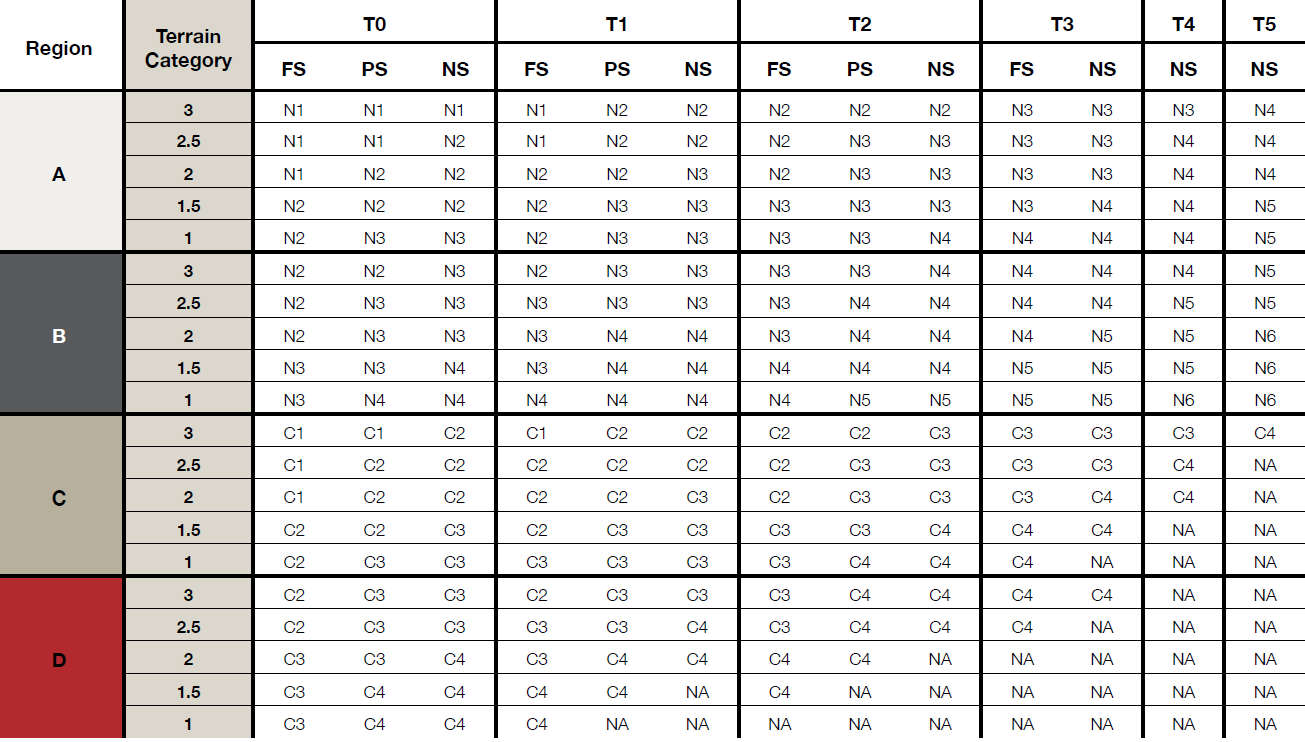
Terrain Category
Wind speed at a structure is influenced by the terrain it flows over as it approaches. Terrain categories are defined as:

Category 1: Exposed open terrain with few/no obstructions (e.g., flat plains, rivers, coastal areas under 10km).

Category 1.5: Open water surfaces (e.g., seas, lakes, bays extending >10km in wind direction).

Category 2: Open terrain with grasslands and well-scattered obstructions (1.5–6m tall, max two per hectare).

Category 2.5: Terrain with a few trees or isolated obstructions (e.g., developing outer urban areas).

Category 3: Terrain with many closely spaced obstructions (3–10m tall, e.g., suburban housing).
Topographic Effect
The topographic classification determines how the location of a structure—such as on a hill, ridge, or escarpment—affects the wind speed it experiences. This depends on the height and slope of the hill, ridge, or escarpment.
Key Points
Topographic Effect (MT)
| Topographic Classifications | Factor |
| T0 | 1.00 |
| T1 | 1.10 |
| T2 | 1.20 |
| T3 | 1.30 |


NOTE: Diagrams suitable for hill or escarpment heights not exceeding 30m. Refer to AS4055:2011 for details if outside of these requirements.
Design Factors
These factors are defined in accordance with AS/NZS1170.2:2011 for a 500-year design return period and an average 9m height of the main structure.
NOTE: A 5% allowance has been used when allocating the wind classification.
Terrain Categories (MZ, cat)
| Terrain Category | Regions A, B, C and D |
| 1 | 1.05 |
| 1.5 | 0.98 |
| 2 | 0.91 |
| 2.5 | 0.87 |
| 3 | 0.83 |

Shielding Factor
Shielding classification accounts for nearby structures that reduce wind speed. Based on the density of surrounding buildings or vegetation:
NS (No Shielding)

PS (Partial Shielding)

FS (Full Shielding)

Wind Speed Examples
The examples below show typical applications of the rationalised gust wind speeds. For a full analysis, refer to AS/NZS1170.2:2011.
Flat Suburbia

Region A – N1 (W28), Region B – N2 (W33) and Region C – C1 (W41)

Structure sited in undulating, sparsely populated terrain
Region A – N3 (W41), Region B – N4 (W50) and Region C – C3 (W60)

Structures built adjacent to an oval or large vacant lot are subject to prevailing winds
Region A – N2 (W33), Region B – N3 (W41) and Region C – C2 (W50)

The first row of buildings adjacent to the sea front
Region A – N3 (W41) Region B – N4 (W50) and Region C – C3 (W60)

Structures on undulating terrain in suburbia
Region A – N2 (W33), Region B – N3 (W41) and Region C – C2 (W50)

Extremely severe – Isolated building on the crest of a hill
Region A – N4 (W50) Region B – N5 (W60) and Region C – C4 (W70)
